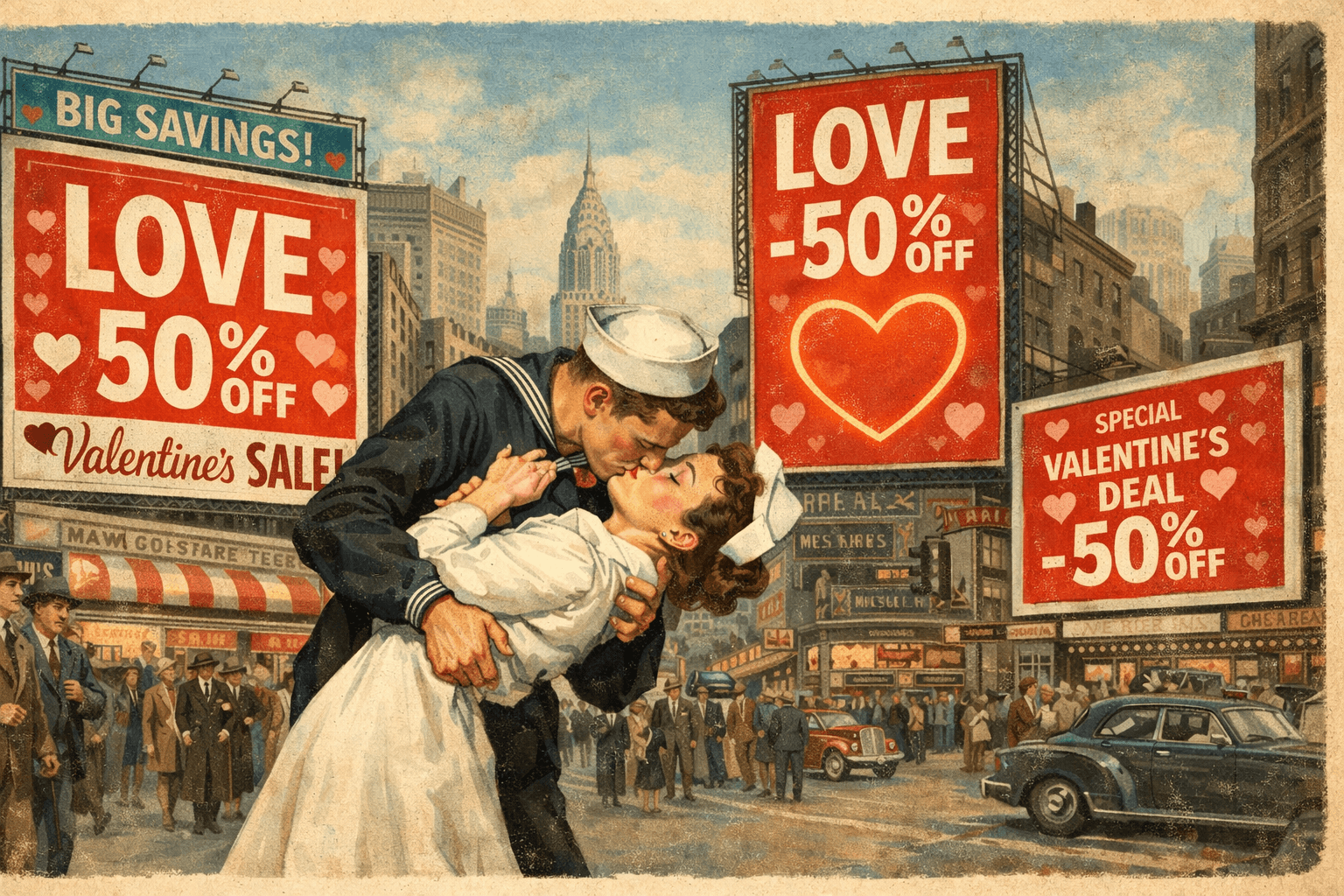

Valentine’s Day 2026 is projected to generate $29.1 billion in U.S. consumer spending. That figure comes from the National Retail Federation and Prosper Insights & Analytics (surveyed Jan 2–8, 2026; 7,791 respondents; margin of error ±1.1%). For anyone whose work touches love marketing – from CMOs to founders building personal brands – this number deserves more than a headline. It deserves closer examination. Because what it measures isn’t love. It measures the cost of proving love to someone who, ideally, shouldn’t need the proof.
Price Tag on Love Marketing
The average American will budget $199.78 this February 14 – a per-person all-time record. Jewelry alone accounts for $7 billion in projected sales, despite only 25% of consumers participating in that category. Read that ratio carefully: a minority of buyers generate the single largest spending block. The gap between participation rate and dollar volume tells you everything about what love marketing actually sells. Not the object. The gesture. Not the diamond. The narrative you construct while purchasing it.
A WalletHub survey (2026) puts it even more bluntly: 60% of respondents say irresponsible spending is a bigger turn-off than bad breath. People know the spending is irrational. They do it anyway. That tension – between knowing and doing – is exactly where love marketing operates.
And it operates efficiently. According to research cited by Gerald Zaltman, a Harvard Business School professor, 95% of purchasing decisions are driven by subconscious emotional processes. The consumer doesn’t choose rationally. The consumer feels, then constructs a justification. Every sophisticated love marketing campaign leverages this sequence – not by manipulating people, but by offering them a story they already want to believe about themselves.
What Is Love – Before Marketing Gets to It
Before examining how marketing borrows love’s machinery, it’s worth establishing what love actually is.
Erich Fromm, the German-American psychologist and philosopher, published The Art of Loving in 1956. His definition remains the sharpest: love is “the active concern for the life and the growth of that which we love.” No deliverables. No price point. Just sustained, deliberate attention toward another person’s becoming. By Fromm’s standard, most Valentine’s spending doesn’t express love. It expresses the anxiety of someone unsure whether the other person knows.
Helen Fisher, the late biological anthropologist at Rutgers University (1945–2024) and chief scientific adviser to Match.com, went deeper. Her fMRI research (Aron et al., 2005, Journal of Neurophysiology) identified three distinct brain systems for human bonding: lust (testosterone/estrogen-driven), romantic attraction (dopamine-driven), and long-term attachment (oxytocin/vasopressin-mediated).
The early dopamine stage – what we call “falling in love” – activates the ventral tegmental area, the same reward circuit triggered by nicotine and cocaine. A Harvard Medical School review noted that early romantic love depletes serotonin to levels found in obsessive-compulsive disorder. Infatuation, neurochemically, is indistinguishable from addiction and anxiety.
This is critical for marketing professionals. The emotional states that brands engineer in their audiences – urgency, exclusivity, FOMO, belonging – mimic the neurochemical profile of early-stage romance with precision that should make us uncomfortable. Or, at minimum, more self-aware.
How Love Marketing Borrows Chemistry of Attachment
The parallel between romantic neurochemistry and brand engagement isn’t metaphorical. It’s structural.
Dopamine drives the “wanting” system – the pursuit of reward, the thrill of novelty. This is what powers early-stage infatuation, and it’s also what powers a flash sale, a limited-edition drop, a countdown timer. The emotional signature is identical: scarcity + anticipation + the fear of missing out.
Oxytocin, by contrast, drives the “having” system – trust, safety, the quiet satisfaction of something reliable. This is what sustains a 20-year marriage, and it’s also what sustains a customer who has been with the same brand for a decade – not because the price is best, but because the relationship is.
The most effective love marketing strategies understand this distinction. They don’t permanently live in dopamine territory. They use dopamine to initiate (campaign launches, seasonal activations, Valentine’s Day itself), then transition into oxytocin-building practices: consistent delivery, transparent communication, the small gestures that compound into trust.
The brands that never make that transition – the ones permanently running on urgency and novelty – are doing the corporate equivalent of serial dating. Exciting? Sure. Sustainable? Never.
Marketing of Love in Practice – Lovemarks and Loyalty
Kevin Roberts, former CEO Worldwide of Saatchi & Saatchi (the global advertising agency behind JCPenney’s $430M account win in 2006), formalized this intuition in 2004 with his “Lovemarks” concept. His argument: brands should aspire to “loyalty beyond reason” through three qualities – mystery, sensuality, and intimacy. The vocabulary is lifted from romance intentionally.
Roberts wasn’t being poetic. He was being strategic. His framework predicted that rational brand preference – built on features and price – would commoditize. What couldn’t be commoditized was emotional attachment. The data supports him: a Lightspeed Commerce study (February 2026 – note: Lightspeed sells POS and e-commerce solutions, so their Valentine’s data serves their commercial interests) found that 62% of consumers feel no external pressure to spend on Valentine’s Day. Yet spending sets records every year. Over one in four consumers now buy Valentine’s gifts for themselves. Among Gen Z, that number reaches 55%.
The conclusion for anyone working with Brand Strategy: people don’t buy love. They buy a version of themselves that feels worthy of it. That reframe – from product to identity – is where the marketing of love stops being a tactic and becomes architecture.
Infatuation vs. Commitment – A Diagnostic for Brands
Fisher’s research established that romantic love evolves through neurologically distinct phases. Early dopamine-driven infatuation is intense but structurally fragile. Long-term oxytocin-mediated attachment is quieter but resilient enough to survive conflict, distance, and boredom.
Brand-consumer relationships follow the exact same arc. The infatuation equivalent is the viral moment – a campaign that spikes, gets shared millions of times, then vanishes without leaving a single structural asset behind. No retained community. No trust infrastructure. No repeat purchase pathway. Dopamine without oxytocin.
Research published in Frontiers in Psychology (He et al., 2022 – funded through university grants, no commercial sponsor disclosed) found that emotional marketing strategies perceived as authentic generate 43% higher customer loyalty than those perceived as manipulative. The implication is worth sitting with: ethical love marketing isn’t just more principled. It’s more profitable. Over time, the brands that survive market downturns are the ones whose emotional bond with customers has matured past the infatuation stage – just as the couples who survive a crisis are those who have already done the quiet work of building trust.
What Mature Love Marketing Looks Like
If infatuation-stage marketing engineers dopamine (urgency, scarcity, fear of missing out), then commitment-stage marketing builds oxytocin (consistency, reliability, earned trust). The practical difference shows up in how a business examines its own emotional footprint on customers.
The questions worth asking: At which touchpoint does a customer first feel recognized – not targeted, but recognized? Where in the journey does trust form, and where does it fracture? Is the brand’s emotional signature something that survives scrutiny, or does it collapse the way a grand Valentine’s gesture collapses when Tuesday follows?
Most organizations never ask these. They measure clicks, conversions, and impressions – the vital signs of infatuation – while ignoring the deeper metrics of attachment: retention after a price increase, referral intent, willingness to forgive a mistake. The brands that build long-term emotional equity treat their reputation with the same rigour as their media budget, because trust, once fractured, doesn’t reassemble on a quarterly cycle.
Question About $29.1 Billion
Every February, the market asks us to prove our affections through purchases. Every February, we comply – $29.1 billion worth.
But the more interesting question – for strategists, for brand builders, for anyone constructing something meant to outlast a quarter – isn’t whether love marketing works. It does. The question is whether your version of it resembles infatuation or commitment. Whether it runs on dopamine or oxytocin. Whether your brand says “I love you” because it means it, or because it’s afraid of what happens when it stops.
Fromm argued that love is not a feeling you fall into. It’s a practice you commit to. The same applies to every brand relationship worth having.
The best marketing doesn’t sell love. It earns it.